
Author guidelines for creating an Arctic Answers Brief
Overview
The Study of Environmental Arctic Change (SEARCH) has partnered with Arctic, Antarctic, and Alpine Research (AAAR) to publish “Arctic Answers” science Briefs that succinctly answer questions about Arctic environmental change and that are framed for policy makers, stakeholders, and other interested audiences. The Briefs are published in AAAR in an easily accessible 2-page format useful in briefing decision makers.
Text of Briefs
Each Arctic Answers Brief should answer a specific, policy-relevant question in clear, non-technical language. The question should be used as the title of the Brief. The text and figures should be readily accessible to sophisticated readers without technical vocabularies. Graphics should be used when they convey information more efficiently than text. Avoid graphics that require close study to extract their meaning. Each Brief must be submitted using the Arctic Answers template and must fit in 2 pages (~1000 words) or less.
References
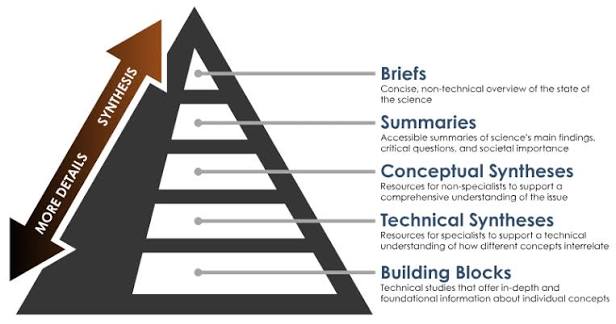
For brevity and clarity, the Brief itself is limited to 6 citations in the Key References section, but additional references must be included in a separate document to be published as a “knowledge pyramid” in supplemental material. Authors submit references as they would for any peer-reviewed paper, but the references are categorized in levels according to their accessibility to audiences with variable technical backgrounds. Thus, references are submitted in two ways: (1) up to 6 key references cited in the Brief, and (2) as a supplemental list of increasingly technical categories in the knowledge pyramid template. Note that the key references will appear both at the end of the Brief as part of the 2-page limit and at the start of the supplemental references comprising the knowledge pyramid.
 Required supplemental material: the Knowledge Pyramid Template
References for the knowledge pyramid are required and must be submitted as supplemental material using the knowledge pyramid template. Please contact us for an editable copy of this template.
In addition to the key references cited in the Brief, the knowledge pyramid includes additional literature supporting or extending the Brief’s content. The pyramid should be thought of as a combination of supporting literature and further reading. The categories of the pyramid include:
- Key References that provide recent, accessible information directly supporting the Brief (limit of 6 also cited in the 2-page Brief),
- Summaries of state-of-the-art information on main findings, critical questions, and societal importance written for non-technical audiences,
- Syntheses that include resources for a comprehensive and often more technical understanding of the issue and how different concepts interrelate, and
- Building Blocks that include technical studies with details and foundational information about individual concepts.
Organization of references into a knowledge pyramid helps readers navigate the accessible-to-technical knowledge spectrum and find the relevant scientific literature arranged in tiers according to the level of detail appropriate to their needs. Knowledge pyramids are required for each Brief and must be submitted with the Brief using the knowledge pyramid template. The pyramids will be published as supplemental material, as provided, and without copy editing.
Peer review
Each Brief is anonymously and rigorously peer-reviewed by science colleagues and readers facile in writing and reading policy Briefs.
Before you start writing …
Prior to writing or submission, topic and authorship must be approved or invited by the AAAR “Arctic Answers” Associate Editor. Arctic Answers Briefs have a specific purpose and must conform to a very specific format. To ensure a wide variety of appropriate topical coverage, and to eliminate needless effort by the author, please email the Associate Editor with your proposed Brief question. If your proposal is approved, an Associate Editor will be assigned to coordinate the review.
Prior to journal submission, all communications about the Brief should be sent to uaf-arcticanswers@alaska.edu and copied to aaarrev@colorado.edu. Please use your Brief title (the question being answered) in the subject line of all subsequent communications until submission to the journal.
General flow from Brief preparation to publication
- Request approval for your proposed Arctic Answers topic.
- Gather references from recent and supporting literature to become the base for the knowledge pyramid. Include hyperlinks if the source is open access or whenever possible. Use The Chicago Manual of Style endnote style for references.
- Prepare a draft once approval is given, referring to the guidance below and following exactly the Brief template and knowledge pyramid template provided.
- Use a question as the title for the Brief. The question should be framed in a manner relevant to a decision-maker.
- Use the formatting template to structure your Brief – see Formatting section below.
- Keep Briefs to 2 pages (< 1000 words total including key references), limit text in the figure captions, and limit to six (6) the key references listed at the end of the Brief. Retain extensive references related to the Brief for the associated knowledge pyramid.
- Submit a Word document for your Brief and knowledge pyramid, following the templates provided (an editable document will be required for final submission).
- Use high-quality colorful photos or easy-to-interpret graphs, single or double column width, ideally one figure per page (2 total maximum). Figures should be 600 dpi for black and white art and 300 dpi for color, saved as TIFF, PostScript, or EPS files. Submit the highest resolution figures you have as separate files (not embedded in the Brief) – failure to submit high-resolution files may delay the production stage of your Brief.
- Figures with data should have no gridlines, minimal text in the figure other than a legend, and easy-to-read (larger font) axis labels and numbers. If used, figure titles should describe the result or conclusion (e.g., “Sea Ice Extent Is Decreasing”).
- Avoid disciplinary jargon and avoid making this a standard “review” of the literature.
- Use bullet points when possible to stress key points.
- Avoid passive voice as much as possible.
- All Brief authors, typically 1 or 2 research experts, will be considered corresponding authors and must be willing to be contacted for questions from the press, decision-makers, or interested parties.
- Formatting of all Brief elements should follow exactly the instructions below, the Brief template, and the knowledge pyramid template (Word documents) provided. Please contact the assigned editor with any questions. Submissions with improper formatting (including references) will be returned to the author.
- BRIEF
List of Authors - TITLE. [State as a question]
- THE ISSUE. [State succinctly in one to two sentences.]
- WHY IT MATTERS. [Non-technical explanation of why the issue is important for decision-making.]
- STATE OF KNOWLEDGE. [Non-technical description of current, state-of-the-art understanding of the issue and its implications. The description should be framed to help a decision-maker appreciate the robustness and limits of current understanding.]
- WHERE THE RESEARCH IS HEADED. [A non-technical description of where research on the issue is headed. This description should help a decision-maker understand the degree to which on-going research will resolve remaining gaps in understanding and how long (a year, 5 years, 10 years, more) it might take to fill those gaps. The description should critically assess the direction and pace of research on the topic and avoid being written merely as a plea for further funding or concluding that “more research is needed”.]
- FUNDING. All Briefs begin with the acknowledgement “This work was supported by the Office of Polar Programs, National Science Foundation”, followed by additional funding sources if necessary. Do not include grant numbers, only the granting agency or institutional support.
- KEY REFERENCES. [List only six (6) particularly significant references and cite using superscript in the text. A fuller list of references will appear in the associated knowledge pyramid. Use The Chicago Manual of Style endnote style for references; include DOI number and pdf link (if available); examples provided in the knowledge pyramid template.]
- CONTACT AUTHORS FOR MORE INFORMATION: List the author name, the institution, and the country (do not include the department, unit, city, or state), and the author’s email address.
- TABLE AND FIGURE CAPTIONS
- TABLES AND FIGURES
- KNOWLEDGE PYRAMID. Assemble all references in the proper format into the knowledge pyramid template. Please contact us for an editable version of this template.
- BRIEF
- Submit the draft through the Arctic, Antarctic, and Alpine Research submission site. Select “Arctic Answers” Brief for the article type. All further communication will occur through the Editorial Manager site. The draft will be assigned to your Associate Editor and anonymously reviewed by at least 2 content area experts, as well as policy staff or experts. We aim to return a first decision and reviews to you within 4 weeks of your submission.
- Revise the draft based on the reviews and resubmit through the Arctic, Antarctic, and Alpine Research submission portal. Your revised Brief is expected within 3 weeks of receiving the reviews, or if an extension is needed, please contact the editor. Please include a detailed point-by-point ‘response to reviewers’ file explaining how you addressed the reviewer comments. Several revisions may be necessary to suit the content requirement or format to the satisfaction of the editors and reviewers. Acceptance is not guaranteed.
- Accepted Briefs will be typeset, and page proofs will be sent to the corresponding author and editor using the Taylor and Francis’ Central Article Tracking System (CATS). Proofs should be carefully checked and returned within 48 hours.
- Article Publication Charge (APC) for an accepted “Arctic Answers” Brief is $600 USD. There is no submission charge.